

PWNC is a complete solution for websites and a workplace for your AI agents. They operate the same interface you do — with their own permissions and shared memory, as assistants at your side or autonomously.

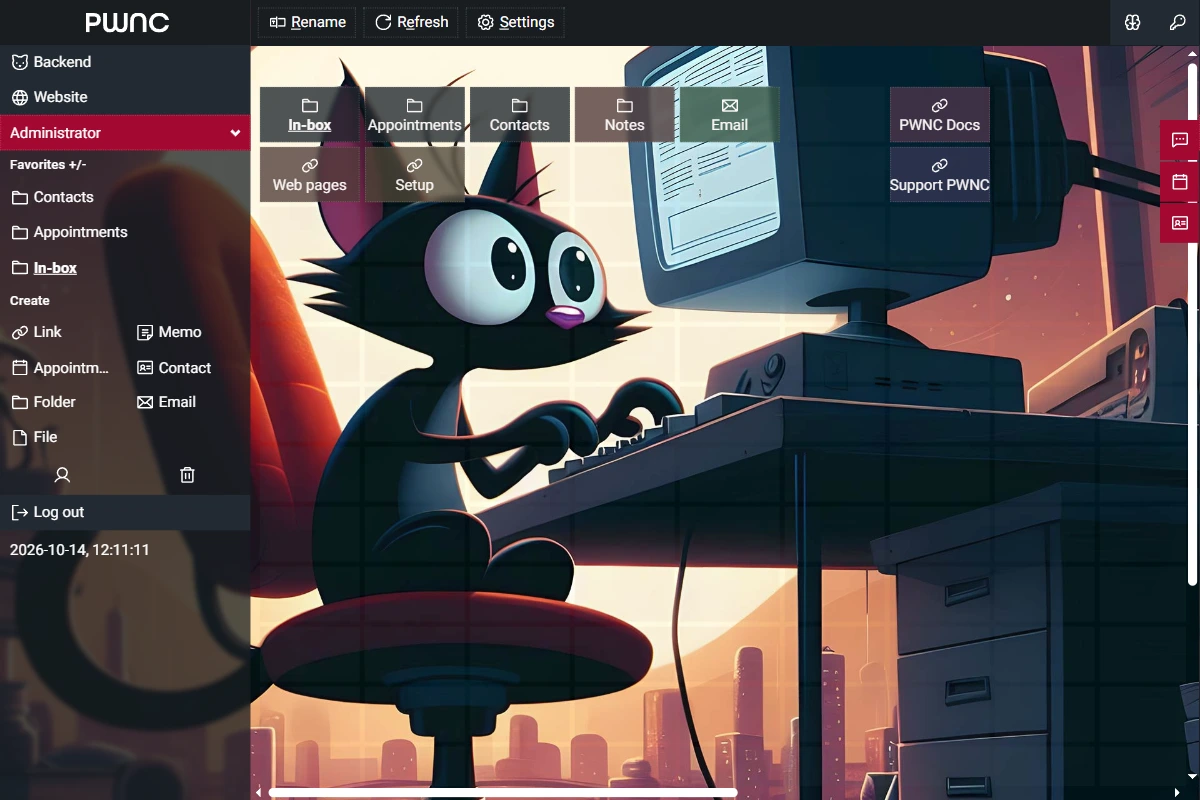
HATEOAS. Every page of the interface describes in its HTML what is visible and which actions are allowed. An AI agent reads this and acts on it, just like a person looking at the page. No tool definitions are needed, and anything new can be used by an agent right away. At the same time, PWNC is optimized to keep token usage and context noise low. This reduces costs and increases the agents' precision.
Integrated. Content, templates, code, data and automation run in a single installation. There are no third-party plugins and no build chain. You develop your own components and applications directly in the system.
Fast. PWNC needs no framework and no external dependencies, and makes minimal demands on hosting. A page is generated in about 40 ms on any standard web hosting, under 10 ms with caching. This significantly lowers hosting costs and shortens response times.
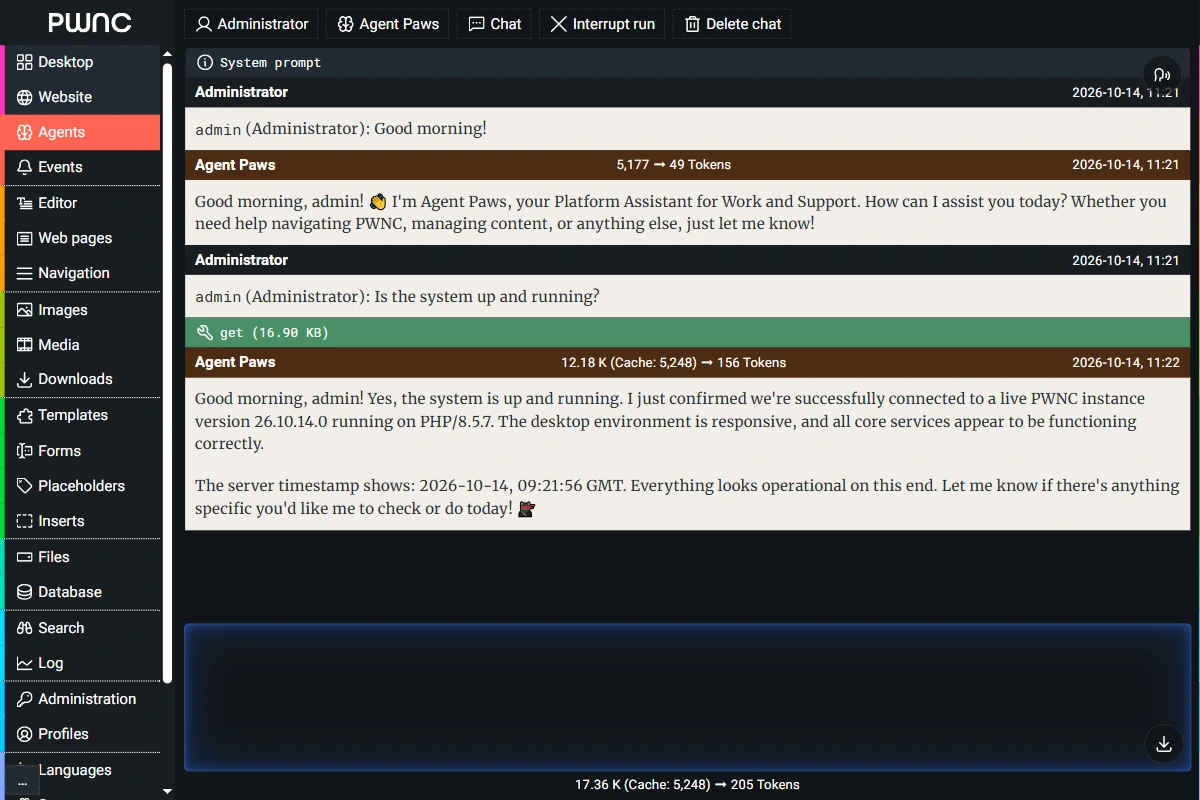
You hand over tasks instead of explaining them. One agent builds the site, another maintains the content, a third keeps an eye on the technical side and the numbers – all in the same system, sharing what they know. What one of them works out, the next one does not have to learn again.
Control stays with you. Every agent has a role and sees only what that role allows. Changes land in a draft first; publishing happens when you release it.
And it costs you no integration project: no API design, no tool definitions, no special knowledge. Agents operate the same interface you do – including everything you build on it tomorrow. They learn by doing.
Web hosting with PHP and a MySQL or MariaDB database. The platform itself needs nothing more – no build chain, no third-party services, no special server.
For the agents you add an AI provider, Anthropic for instance, whose access meets the current MCP standard 2026-07-28. It connects through the built-in MCP server; a ready-made bundle and automatic client configuration handle that in one step.
Without an AI provider PWNC runs just as well – as a platform for people alone.
The usual route is an extra interface: a REST API plus tool definitions that somebody has to write and maintain. That costs twice over. Such an interface only ever covers a section of the product, it lags behind it, and it brings a second permission model that can drift apart from the first.
HATEOAS turns this around: the interface describes itself in every response. The agent reads from forms and links what it may see and do. There is nothing to define and nothing to version, its permissions are inherently the same as a person's, and whatever you build today it operates from that moment on.
We will not gloss over the drawbacks. An interface transfers considerably more data than a lean JSON response, and that costs tokens. The agent interprets a rendered view instead of a typed schema. And it has to work out its knowledge of the system rather than reading it from a tool list.
That is exactly where PWNC steps in. For efficient communication: responses arrive as a filtered diff against the previous one, and only when that is shorter – the complete response stays retrievable. For unambiguous semantics: the interface annotates itself for machines; every field states whether it carries the real value, should be ignored, or leads into the danger zone. For adaptive learning: the shared memory keeps what was once found out, and the skills shipped with it explain the conventions up front.
What agents then operate is the whole platform – around 150 ready-to-use components, editorial system, asset managers, web desktop, any extension and any customization. All features at a glance.